Hair Loss During Menopause: Why It Happens and 7 Things That Actually Help
You used to have to thin your hair so it wouldn’t be too full. Now you’re staring at the drain after every shower, watching strands wash away. Your part looks wider than it used to. Your ponytail feels thinner. You’ve started avoiding the harsh light of bathroom mirrors.
If this sounds like you — you’re not imagining it, and you’re far from alone. Up to 50% of women experience noticeable hair loss or thinning during perimenopause and menopause. And for most of them, no one ever warned them this was coming.
Hair loss during menopause is one of the most emotionally distressing symptoms a woman can experience — because unlike hot flashes or mood swings, it’s visible. It’s something other people might notice. And it can deeply affect how you feel about yourself.
Here’s the encouraging part: menopausal hair loss is one of the most treatable symptoms when you address its root causes. In this guide, we’ll break down why your hair is changing, what’s actually happening to your follicles, and 7 strategies that genuinely help women slow thinning and even encourage regrowth.
What Hair Loss During Menopause Actually Looks Like
Menopausal hair loss is different from sudden hair loss caused by stress, illness, or other conditions. It typically shows up in patterns that women describe similarly:
- Diffuse thinning across the entire scalp (not in patches)
- A widening center part
- More hair in the shower drain, hairbrush, or pillow
- A thinner, lighter ponytail
- Visible scalp where it wasn’t visible before
- Hair that feels finer, drier, or more brittle
- Slower regrowth when hair does shed
- Some women also notice new facial hair (chin, upper lip)
The medical term for this pattern is female pattern hair loss or androgenetic alopecia — and the hormonal shifts of menopause are a primary trigger.
Why Menopause Causes Hair Loss
Menopausal hair loss is driven by very real, measurable hormonal changes. Three main factors are at work:
1. Estrogen Declines
Estrogen plays a key role in keeping hair in the growth phase (called anagen). Higher estrogen levels mean hair stays in the growth phase longer, producing thicker, fuller hair. As estrogen drops during perimenopause and menopause, more hair shifts into the resting and shedding phases — and stays there longer before regrowing.
The result: hair sheds at a normal rate, but regrows more slowly. Over time, this creates noticeable thinning.
2. Androgens Become Relatively Dominant
Women produce small amounts of androgens (male-pattern hormones) throughout life. While estrogen is high, these androgens have minimal effect. But as estrogen drops, androgens become relatively more dominant.
One of these — DHT (dihydrotestosterone) — directly affects hair follicles, causing them to shrink and produce thinner, finer hair over time. This is the same hormone that causes male pattern baldness.
This is also why some women notice new chin hairs or thicker facial hair while losing hair from their scalp — same hormonal shift, different follicle response.
3. Cortisol and Stress Make Everything Worse
Chronic stress and elevated cortisol — common during perimenopause — push hair into the resting phase prematurely. This causes a type of hair loss called telogen effluvium, which can dramatically accelerate the natural thinning of menopause.
If your hair loss feels like it spiked during a particularly stressful period, this is likely why. (For more on managing cortisol during menopause, see our guide on menopause belly and the cortisol connection.)
4. Nutrient Deficiencies Common in Midlife
Hair needs specific nutrients to grow well — protein, iron, zinc, biotin, vitamin D, and B vitamins among them. Women in midlife are frequently low in one or more of these, often without realizing it. Even when hormones are the trigger, poor nutrition amplifies the problem.
7 Things That Actually Help With Menopausal Hair Loss
Hair regrowth is slow — strands grow about half an inch per month — so any approach takes time to show visible results. Most women see meaningful improvement within 3-6 months of consistent effort. Here’s what genuinely works.
1. Eat Significantly More Protein
Hair is made primarily of a protein called keratin. If you’re not eating enough protein, your body deprioritizes hair growth in favor of more essential functions.
Most women in midlife dramatically under-eat protein. Aim for 25-35 grams per meal and at least 90-120 grams per day. Practical sources:
- Eggs (high in biotin too)
- Greek yogurt or cottage cheese
- Fish, especially salmon (omega-3 bonus)
- Chicken, turkey, lean beef
- Tofu, tempeh, lentils
- Collagen peptide powder added to coffee or smoothies
This single change often produces visible hair improvement within 2-3 months.
2. Test for Key Nutrient Deficiencies
Hair loss is sometimes a warning sign of an underlying deficiency. Ask your doctor to test:
- Ferritin (iron stores — low ferritin is one of the most common hair loss causes in women)
- Vitamin D (deficiency is rampant and affects hair)
- Vitamin B12
- Zinc
- Thyroid function (TSH, free T3, free T4)
Many women have been told their hair loss is “just menopause” when there was actually a fixable deficiency. Don’t skip this step.
3. Use a Scalp-Stimulating Routine
The scalp environment matters more than most women realize. Blood flow to the scalp directly affects follicle health, and many midlife women have inflamed or congested scalps without knowing it.
Simple practices that help:
- Gentle daily scalp massage (2-5 minutes — increases blood flow to follicles)
- Weekly scalp exfoliation with a specialized brush or product
- Avoiding tight ponytails or hairstyles that pull on the hairline
- Using gentle, sulfate-free shampoos
- Treating dandruff or scalp inflammation if present
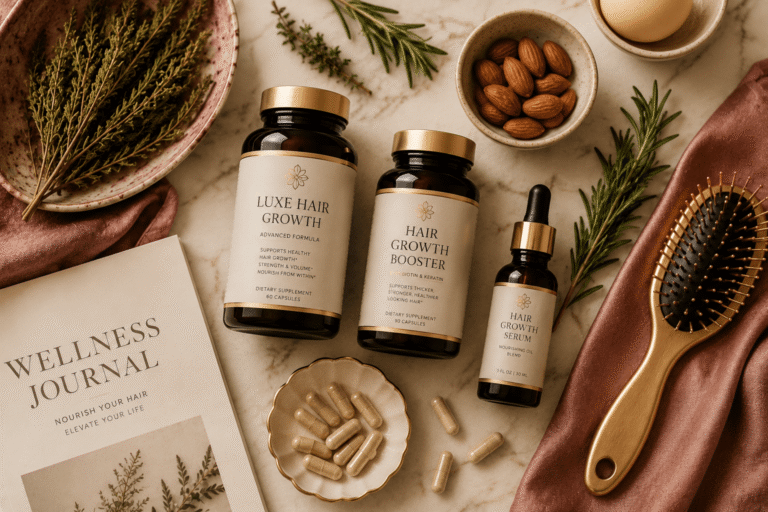
4. Consider a Targeted Hair Growth Supplement
For women dealing with persistent menopausal hair loss, a targeted hair growth supplement can be a meaningful addition to a healthy routine. Look for formulas that combine:
- Biotin — supports keratin production
- Marine collagen — supports hair structure
- Saw palmetto — may help block DHT
- Iron (if deficient) — essential for hair growth
- Zinc and selenium — support follicle health
- Vitamin D and B-complex — foundational for hair
Consistency matters more than dose. Hair supplements need 3-6 months to show visible results. Always talk to your healthcare provider before starting new supplements, especially if you’re on medication.
5. Manage Cortisol and Stress
Since stress amplifies hair loss in menopause, calming the cortisol response is essential. Daily practices that work:
- 7-9 hours of consistent sleep
- Daily walking, ideally in morning sunlight
- Paced breathing (5 in, 5 out) for 5-10 minutes
- Limiting alcohol and caffeine
- Real downtime without screens
The intersection of stress, sleep, and hormonal balance is enormous — and addressing it can dramatically reduce stress-driven hair loss within 2-3 months.
6. Be Gentle With Your Hair
Hair is more fragile during menopause. The same heat tools, chemical treatments, and tight styles you used at 30 can cause much more damage now.
- Air-dry when possible
- Use heat protectant if you do use heat tools
- Avoid bleaching or harsh chemical treatments while regrowing
- Sleep on a silk or satin pillowcase to reduce friction
- Use a wide-tooth comb on wet hair, never a brush
- Skip tight ponytails and buns
7. Consider Medical Options If Severe
If hair loss is significant or affecting your quality of life, talk to your healthcare provider or a dermatologist. Real medical options include:
- Topical minoxidil (the only FDA-approved treatment for female pattern hair loss)
- Spironolactone (prescription medication that blocks androgens)
- Hormone therapy — may help hair as part of broader treatment
- PRP (platelet-rich plasma) injections — newer, in-office treatment
- Low-level laser therapy — at-home or in-office devices
These aren’t right for everyone, but they’re effective options that many women don’t know about.
What NOT to Do
A few common mistakes that actually make hair loss worse:
- Drastically cutting calories — your body will deprioritize hair growth
- Going on extreme low-fat diets — hair follicles need healthy fats
- Skipping protein — addressed above
- Constant tight hairstyles — causes traction alopecia over time
- Believing every miracle product on Instagram — most haven’t been studied
- Giving up after 4 weeks — hair takes months to respond
When to See a Dermatologist
Reach out to a dermatologist or healthcare provider if:
- Hair loss is sudden, severe, or in patches
- You notice bald spots, not just thinning
- Hair loss is accompanied by other symptoms (rapid weight changes, fatigue, hair coming out by the handful)
- Lifestyle changes haven’t helped after 6 months
- You want to explore prescription or in-office options
A dermatologist can rule out other causes (thyroid issues, autoimmune conditions, alopecia areata) and prescribe effective treatments.
A Realistic Timeline
Hair regrowth is genuinely slow — and that’s not a marketing problem, it’s biology. Here’s what to expect:
- Weeks 1-4: Nothing visible. Your nutrition and routine improvements are happening at the follicle level.
- Months 2-3: Less hair in the shower. Possibly new short, fine baby hairs at the hairline.
- Months 3-6: Noticeable density improvement. Existing hair feels stronger. New regrowth more visible.
- Months 6-12: Real, sustained improvement. The version of your hair that emerges may not be the exact same as your 30-year-old hair — but it will be noticeably better than the worst point.
Similar Posts
Best Vision Supplements 2026: An Honest Buyer’s Guide for Women 40+
If you’ve been researching the best vision supplements because reading feels harder, your eyes get tired faster, or you’re worried about protecting your sight for the next 30-40 years — you’re asking the right questions at exactly the right time. Vision changes affect over 70% of women during perimenopause and menopause, yet most eye supplement…
Best Hair Growth Supplements 2026: An Honest Guide for Women 40+
If you’ve been researching the best hair growth supplements for women 40+ dealing with menopause hair thinning, sudden shedding, or slower regrowth — you’ve probably realized something frustrating: most reviews are indistinguishable, everyone claims the same benefits, and it’s nearly impossible to tell which products actually deliver. After a year of testing, researching, and specifically…
Best Collagen for Women 2026: An Honest Buyer’s Guide for Skin, Hair & Joints After 40
Somewhere between your late 30s and early 40s, something shifts. Your skin looks thinner. Fine lines settle in deeper. Your hair loses body. Your nails peel. Joints ache in ways they never did before. If you’re a woman searching for the best collagen for women, you’ve probably already figured out that this isn’t just aging…
Menopause and Cholesterol: The Hidden Connection Most Doctors Don’t Explain
If you’ve had blood work recently and your cholesterol numbers came back higher than they used to be — despite no major changes in your diet or lifestyle — you’re not alone, and you’re not doing anything wrong. The connection between menopause and cholesterol is real, well-documented, and something most doctors don’t take the time…