Best Collagen for Women 2026: An Honest Buyer’s Guide for Skin, Hair & Joints After 40
Somewhere between your late 30s and early 40s, something shifts. Your skin looks thinner. Fine lines settle in deeper. Your hair loses body. Your nails peel. Joints ache in ways they never did before. If you’re a woman searching for the best collagen for women, you’ve probably already figured out that this isn’t just aging — it’s the estrogen-collagen collapse nobody warned you about.
Here’s the good news: collagen supplements can genuinely help. The bad news? The vast majority of collagen products on the market are barely absorbed, wrong for women 40+, or just overpriced protein powder with a pink label.
After a year of testing, researching, and reviewing dozens of options — and specifically evaluating what actually works for women 40+ dealing with menopause skin, hair, and joint changes — here’s what delivers in 2026.
Quick Decision Guide
Not sure where to start? Here’s the shortcut:
→ Best overall (skin + hair + joints): Collagen Refresh
→ Best for skin elasticity specifically: Marine collagen with vitamin C
→ Best for joint pain: Type II collagen (different from skin collagen)
→ Best for hair regrowth: Collagen + biotin combos
→ Want the complete menopause picture? See our full supplements guide
Why Collagen Matters More After 40
Collagen is the most abundant protein in your body — it’s what gives your skin structure, keeps your joints cushioned, holds your hair follicles in place, and maintains the strength of your bones, tendons, and blood vessels. Think of it as the scaffolding that holds everything together.
Here’s what changes after 40:
Collagen production plummets. Starting in your late 20s, your body produces about 1% less collagen every year. By age 50, most women have lost 30% or more of their collagen.
Estrogen decline accelerates the collapse. Estrogen directly stimulates collagen production. When estrogen drops during perimenopause and menopause, collagen loss can accelerate to 30% within the first five years post-menopause. That’s why menopausal skin feels dramatically different — thinner, drier, less bouncy.
Repair slows down. Your body still breaks down collagen as needed, but rebuilding it becomes harder without estrogen’s support.
You feel it everywhere. Skin thinning. Fine lines and crepiness. Hair thinning. Nail brittleness. Joint stiffness. Even bladder support and vaginal tissue depend on collagen — and both weaken during menopause for the same reason.
According to research summarized by the National Institutes of Health, supplementing collagen can measurably improve skin elasticity, hydration, and joint comfort in women over 40 — but the delivery form matters enormously.
The Types of Collagen You Actually Need
Not all collagen is the same. Your body contains at least 28 different collagen types, but three matter most for women 40+:
Type I collagen (skin, hair, nails, bones): This is 90% of the collagen in your body. It’s what gives your skin structure and elasticity. Marine collagen is almost entirely Type I, making it particularly effective for skin concerns.
Type II collagen (cartilage, joints): This is what cushions your joints. If your primary concern is joint pain or stiffness, Type II is what you need. It comes primarily from chicken sternum cartilage.
Type III collagen (skin, blood vessels, organs): Works alongside Type I to support skin firmness and vascular health. Found in bovine collagen sources.
Most quality collagen supplements for women 40+ focus on Types I and III together, because these support the whole system — skin, hair, nails, bones, and organs.
The Absorption Problem
Here’s the crucial issue almost nobody talks about: your body can’t absorb whole collagen protein. It’s too large a molecule to pass through your intestinal wall intact.
For collagen to actually reach your skin, hair, and joints, it must first be broken down into smaller peptides through a process called hydrolyzation. Hydrolyzed collagen peptides (sometimes labeled “collagen hydrolysate”) are absorbed 90% or better.
Non-hydrolyzed collagen? Mostly wasted.
This is why some cheap collagen powders show almost no results. It’s not that collagen doesn’t work — it’s that you can’t actually use what you’re taking.
How I Chose These Supplements
Not every collagen supplement makes this list. Here’s what I look for:
Hydrolyzed collagen peptides. Non-negotiable. If the label doesn’t say “hydrolyzed” or “collagen peptides,” skip it.
Includes vitamin C. Vitamin C is required for your body to actually synthesize collagen from the amino acids you’re providing. Without it, you’re only getting partial benefit.
Third-party tested. Marine and bovine collagen can be contaminated with heavy metals. I only recommend brands with independent lab verification.
Formulated for women 40+. Not just a “muscle building” collagen repackaged pink. Real thought given to menopausal skin, hair, and joints.
Money-back guarantee. If a company won’t stand behind their product for at least 60 days, don’t trust it.
Real dosing. A proper daily dose is 10-20g of hydrolyzed collagen. Anything under 5g is basically homeopathic.
A Reality Check
Collagen works, but it’s not magic. If you’re getting 4 hours of sleep, skimping on protein, and living on sugar — no collagen supplement will save your skin. The fundamentals matter first.
The women who see real results combine collagen with sleep, protein-focused eating, and stress management. Collagen amplifies the foundation — it doesn’t replace it. Expect 60-90 days minimum to see visible changes.
The Best Collagen Supplements for Women 40+ in 2026
#1 — Collagen Refresh (Best Overall for Menopause)
Best for: Women 40+ who want a complete solution for skin, hair, nails, and joint support — not just one benefit at a time.
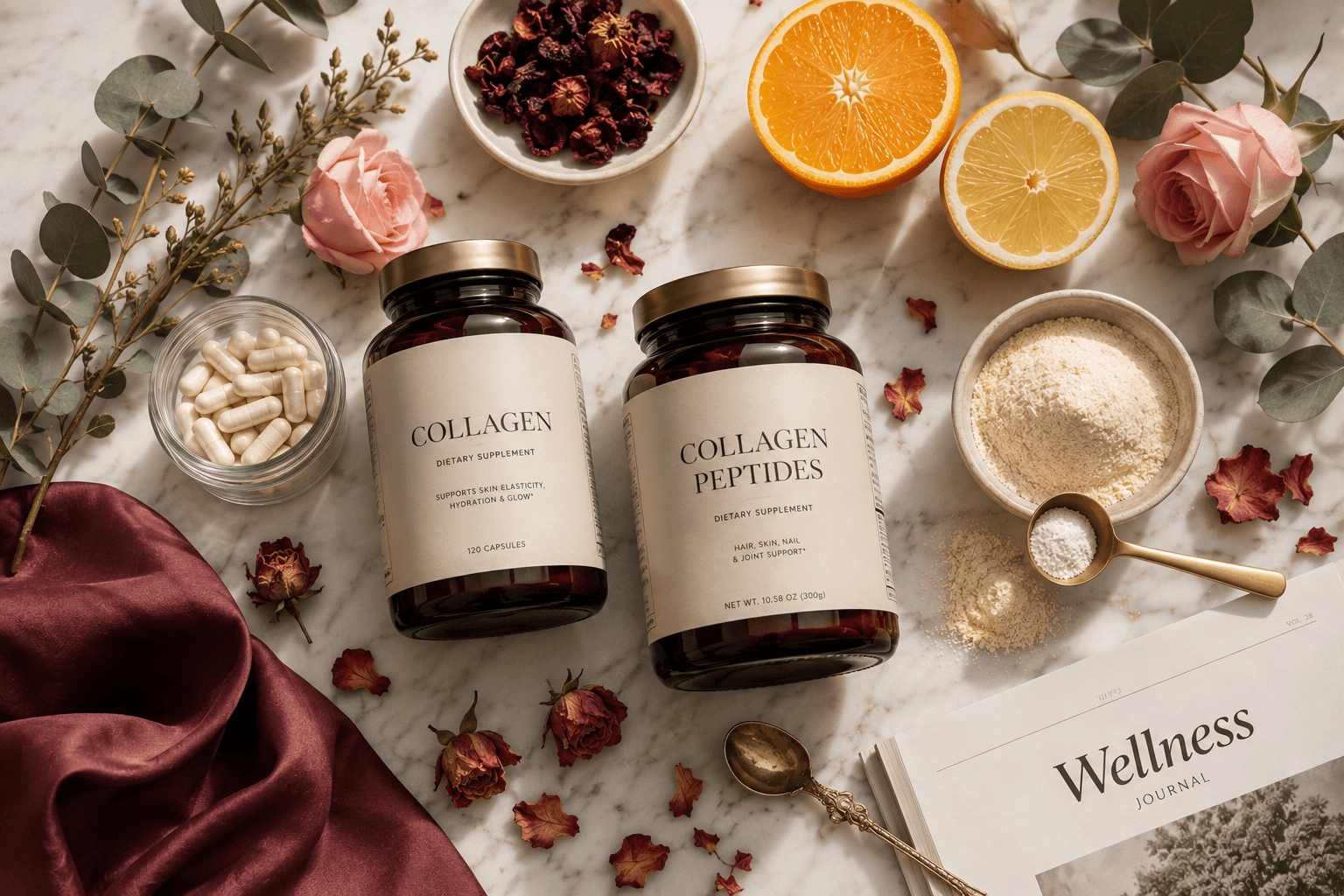
Collagen Refresh has become my top recommendation for a simple reason: it’s formulated for the exact biology of women 40+ instead of being a generic collagen powder. The formula combines hydrolyzed marine collagen peptides (predominantly Type I) with the co-factors your body actually needs to use them.
What makes it different: it includes vitamin C, hyaluronic acid, and biotin — the exact combination dermatologists recommend for complete skin support. This isn’t just protein powder. It’s a full system designed to actually rebuild what menopause is breaking down.
What women notice: Skin feels plumper and more hydrated by week 4. Fine lines soften. Hair grows in stronger. Nails stop peeling. Joints feel less “creaky” in the morning. Many women report visible improvement in skin quality by month 2.
Downsides: Marine-based (not suitable for shellfish allergies). Powder form requires mixing. Premium price point.
Guarantee: 60-day money-back guarantee.
→ Check Collagen Refresh on the Official Site
Read our full honest Collagen Refresh review →
#2 — Marine Collagen Peptides (Best for Skin Focus)
Best for: Women whose primary concern is skin elasticity, hydration, and appearance — with less focus on joints or hair.
Pure marine collagen peptides deliver primarily Type I collagen — the type most concentrated in your skin. Studies show marine collagen has 1.5x better bioavailability than bovine collagen due to smaller peptide size.
Look for a product with at least 10g per serving and paired with vitamin C. Without vitamin C as a co-factor, your body can’t build new collagen effectively.
What women notice: Improved skin hydration by weeks 4-6. Softer fine lines by month 2-3. Consistent daily use is essential.
Downsides: Fish-based (allergy consideration). Doesn’t specifically address joint or hair concerns as strongly.
#3 — Multi-Collagen Blends (Best for Whole-Body Support)
Best for: Women who want to cover all bases — skin, joints, and hair — with a single supplement.
Multi-collagen blends combine Types I, II, III (and sometimes V and X) from multiple sources: marine, bovine, chicken, and eggshell. The theory is that different types support different tissues.
The reality: these blends can be effective but are often lower quality because they’re spread thin across multiple sources. Look for hydrolyzed blends with at least 15g total collagen per serving.
What women notice: Moderate improvement across skin, hair, and joints. Not as dramatic as a targeted single-type collagen for any specific concern.
Downsides: Often underdosed per collagen type. Quality varies wildly between brands. Multiple animal sources may not suit certain diets.
#4 — Bovine Collagen (Budget Option)
Best for: Women on a tight budget who want to try collagen before investing more.
Bovine (cow-derived) collagen provides Types I and III — a good combination for skin and structural tissues. It’s typically the most affordable per gram and comes in unflavored powder form that mixes easily.
This is a solid entry-level option. It’s not as bioavailable as marine collagen, but it works if you use it consistently.
What women notice: Some improvement in skin quality and joint comfort after 8-12 weeks. Results build slowly but do appear with consistency.
Downsides: Lower absorption than marine collagen. Not for those avoiding beef products. Sourcing quality varies (grass-fed matters).
#5 — Vegan “Collagen Boosters” (Plant-Based Alternative)
Best for: Vegan women or those avoiding animal products entirely.
Here’s the truth: there’s no such thing as vegan collagen. Collagen is exclusively an animal protein. What you’ll find labeled as “vegan collagen” are supplements containing the amino acids and co-factors your body needs to produce its own collagen — typically vitamin C, silica, biotin, zinc, and specific amino acids like proline and glycine.
These work, but more slowly and less predictably than direct collagen supplementation.
What women notice: Gradual improvement over 3-6 months. Less dramatic but real for those who stick with it consistently.
Downsides: Slower results. Depends heavily on your body’s ability to synthesize collagen (which declines with age).
My Honest Recommendation
If you want the most complete solution designed specifically for women 40+, Collagen Refresh is where I’d start. The formula addresses the estrogen-collagen collapse comprehensively — skin, hair, nails, and joints — with the co-factors your body actually needs to use what you’re taking.
If you’re strictly focused on skin and want to try marine collagen from a different brand, look for pure hydrolyzed marine peptides with vitamin C and at least 10g per serving.
If you’re on a tight budget, quality bovine collagen from a reputable third-party tested brand can work if you commit to daily use for at least 3 months.
Skip anything under 5g per serving, anything without hydrolyzation, and anything with a “proprietary blend” hiding the actual collagen content.
How to Take Collagen for Best Results
Consistency beats perfection. Take it every day. Missing 3 days a week undermines the entire benefit.
Any time works. Some sources recommend empty stomach, others with meals. Studies show no significant difference. Do what fits your routine.
Mix into anything. Coffee, tea, smoothies, yogurt, oatmeal. Quality hydrolyzed collagen is nearly tasteless.
Pair with vitamin C. If your collagen doesn’t include it, take vitamin C separately. Without it, you’re not building new collagen.
Give it 90 days minimum. Weeks 1-4 show subtle changes (better nails, smoother skin texture). Weeks 8-12 are where visible skin improvement usually appears. Joint benefits often take longer — 3-6 months.
Track what matters. Not just appearance — note nail strength, hair shedding, joint stiffness in the morning, and skin hydration. These often improve before you see the mirror changes.
Frequently Asked Questions
How much collagen do I need daily?
Research suggests 10-20g of hydrolyzed collagen peptides daily for measurable results. Anything under 5g is unlikely to make a real difference.
Can I take collagen with other supplements?
Yes, collagen pairs well with almost everything. Common combinations: collagen + MenoRescue (hormonal support), collagen + magnesium (bone health), collagen + omega-3 (skin barrier).
Does collagen cause weight gain?
No. Collagen provides only about 40-70 calories per serving and doesn’t contain sugar or fat. Some women actually experience reduced appetite from the protein satiation.
How long until I see results?
Nails typically respond first (weeks 4-6). Skin hydration improves by weeks 6-8. Visible fine line and firmness changes usually appear by weeks 12-16. Joint benefits often take 3-6 months.
Is collagen safe for menopause?
Yes, and it’s especially beneficial. Menopause accelerates collagen loss dramatically, and supplementation can partially offset this decline. Just verify sourcing quality and third-party testing.
Can I get enough collagen from food?
Bone broth contains collagen, but you’d need to drink several cups daily to match a supplement dose. Most women don’t get therapeutic amounts from food alone.
What to Skip (Save Your Money)
A quick warning about collagen products to avoid:
“Collagen creams and serums.” Collagen molecules are too large to penetrate skin topically. These are essentially expensive moisturizers with collagen marketing. Save your money for oral supplementation.
Collagen “gummies” with 1-2g per serving. Adorable packaging, essentially useless doses. You’d need to eat 10+ gummies daily to approach therapeutic levels — with all the added sugar.
Non-hydrolyzed collagen. If the label just says “collagen” without “hydrolyzed” or “peptides,” it won’t absorb properly.
Multi-source blends with proprietary formulas. If the brand won’t tell you how much of each collagen type is in the product, assume they’re all underdosed.
Collagen with high sugar or artificial sweeteners. Common in flavored versions. The added sugar undermines the anti-aging benefits you’re trying to achieve.
The Bottom Line
The best collagen for women in 2026 isn’t necessarily the trendiest or the most expensive. It’s the one that combines hydrolyzed peptides + vitamin C + adequate dosing + third-party testing + formulation specifically for women 40+.
For most women dealing with menopause skin, hair, and joint changes, Collagen Refresh offers the best complete solution. Start there, give it 90 days consistently, and evaluate.
Your skin can absolutely bounce back. Not to what it was at 25 — but to what it should be at 45 or 55, with the support your body needs during this transition.
Related Reading
- Complete Menopause Symptoms Guide (35+ Signs)
- Best Menopause Supplements 2026: Complete Guide
- Best Collagen for Women Over 40: Complete Guide
- Collagen Refresh: Full Honest Review
- Menopause Skin Changes: What Really Helps
- Hair Thinning After 40: Complete Guide
- Menopause Joint Pain: Why It Happens
- Best Berberine Supplements 2026
Your Next Steps
Ready to start? → Read our full Collagen Refresh review
Want the complete menopause picture? → See our full supplements guide
Skin concerns specifically? → Read about menopause skin changes
Bloom At 40 may earn a small commission when you purchase through our links, at no extra cost to you. We only recommend products we’ve researched thoroughly and believe genuinely help women 40+. This article is for educational purposes and does not replace medical advice from your healthcare provider. Thank you for supporting our work.