Best Collagen for Women Over 40: A Complete Guide
If you’ve been searching for the best collagen for women over 40, you’ve probably noticed something overwhelming: there are hundreds of products, conflicting advice, and almost no clear answers about which one actually works for midlife bodies.
You’ve heard everyone talking about collagen — your friend, your aesthetician, every wellness influencer on Instagram. The promises are everywhere: smoother skin, thicker hair, stronger nails, better joints, even improved gut health. But which collagen actually works? Which ones are scams? And what should a woman over 40 specifically be looking for?
The collagen supplement market is worth over $10 billion globally — and most of what’s on store shelves was formulated for the general population, not for the very specific needs of women navigating perimenopause and menopause.
This guide cuts through the noise. We’ll explain why collagen matters so much more after 40, which types of collagen do what, the criteria for choosing a quality product, our top picks for women in midlife, and the common mistakes that waste your money.
No hype. No miracle claims. Just honest, science-based guidance for the women whose bodies actually need this kind of support most.
Why Collagen Matters So Much After 40
Collagen is the most abundant protein in your body — it’s the structural framework for your skin, hair, nails, joints, ligaments, gut lining, and even blood vessels. As long as your body produces collagen well, your tissues stay firm, elastic, and resilient.
Here’s what nobody tells you: collagen production drops about 1% per year starting in your late 20s — and accelerates dramatically during menopause. Studies show women can lose up to 30% of their skin’s collagen in the first 5 years of menopause alone.
This is why so many women describe the changes after 40 as feeling like everything happened “all at once”:
- Skin loses firmness and develops new fine lines
- Hair thins and grows slower
- Nails become more brittle
- Joints feel stiffer (especially mornings)
- Gut sensitivities seem to appear out of nowhere
- Recovery from exercise takes longer
All of these have ONE common thread: collagen decline driven by dropping estrogen. (Yes — estrogen is essential for collagen production. When estrogen drops in menopause, collagen drops with it.)
This is why supplementing collagen during midlife isn’t vanity — it’s biology.
The 5 Types of Collagen (and Why Most Matter)
Not all collagen is the same. There are actually 28 known types, but only 5 are functionally relevant for supplementation:
Type I — Skin, Hair, Nails, Bones
The most abundant type in the body — about 90% of all collagen. This is what keeps your skin firm and your hair growing strong. Top priority for women 40+.
Type II — Joints & Cartilage
Specifically supports cartilage and joint health. Crucial if you’re dealing with menopause joint pain or stiffness.
Type III — Skin Elasticity, Blood Vessels
Works alongside Type I for skin structure. Also supports cardiovascular tissue. Often paired with Type I in quality formulas.
Type V — Cell Surfaces, Hair
Found in hair, placenta, and cell surfaces. Important for hair growth and tissue formation.
Type X — Joint Repair
Helps with bone and joint repair. Most relevant if you have specific joint concerns or have had joint injuries.
Best practice: Look for a multi-collagen formula that contains at least Types I, II, III, V, and X — this covers the full spectrum of needs for women 40+.
What to Look For in a Quality Collagen Supplement
Here are the 7 criteria that separate a great collagen supplement from a waste of money:
1. Hydrolyzed (Collagen Peptides)
Look for “hydrolyzed collagen” or “collagen peptides” on the label. This means the protein is broken down into smaller pieces that your body can actually absorb. Non-hydrolyzed collagen is mostly excreted unused.
2. Multi-Type (I, II, III, V, X)
A formula with multiple collagen types covers more tissue systems. Single-type collagen (just Type I, for example) only helps skin/hair/nails — not joints or gut. Pay extra for multi-type.
3. Includes Vitamin C
Your body cannot produce or use collagen properly without vitamin C. Quality formulas include it directly. If yours doesn’t, take a vitamin C supplement alongside.
4. Sourced From Quality Animals (Grass-Fed, Wild-Caught)
Collagen comes from bovine (cow), marine (fish), chicken, or eggshell membrane sources. Grass-fed bovine and wild-caught marine collagen are the cleanest, highest-quality options. Avoid mystery “blends” with no source transparency.
5. Third-Party Tested
Heavy metal contamination is a real concern in collagen products (especially marine sources). Look for brands that publish third-party testing results.
6. No Unnecessary Fillers, Sugars, or Sweeteners
Many “fancy” collagen products are 60% sugar or artificial sweeteners. Look for clean ingredient lists — collagen, vitamin C, maybe a few targeted nutrients. That’s it.
7. Reasonable Dose (10g+)
Research-backed dosing is typically 10–20 grams per day for visible results. If a product offers only 2–5g per serving, you’d need 3–4 servings to match clinical results — which makes it overpriced per gram.
🥇 Our Top Pick: Collagen Refresh by WellMe
Best for: Women 40+ wanting an all-in-one collagen formula that addresses skin, hair, joints, and gut at the same time.
Collagen Refresh stands out because it doesn’t just give you collagen — it gives you a multi-system rejuvenation formula built specifically for women in midlife. The formula combines hydrolyzed collagen peptides (Types I, II, III, V, and X) with the cofactors and nutrients your body actually needs to USE that collagen.
What makes it different:
- ✅ 5 collagen types (I, II, III, V, X) in one formula
- ✅ Hyaluronic acid for skin and joint hydration
- ✅ Vitamin C included for proper collagen synthesis
- ✅ Hydrolyzed peptides for maximum absorption
- ✅ Hormone-friendly formula — designed for menopausal bodies specifically
- ✅ 180-day money-back guarantee — generous trial period
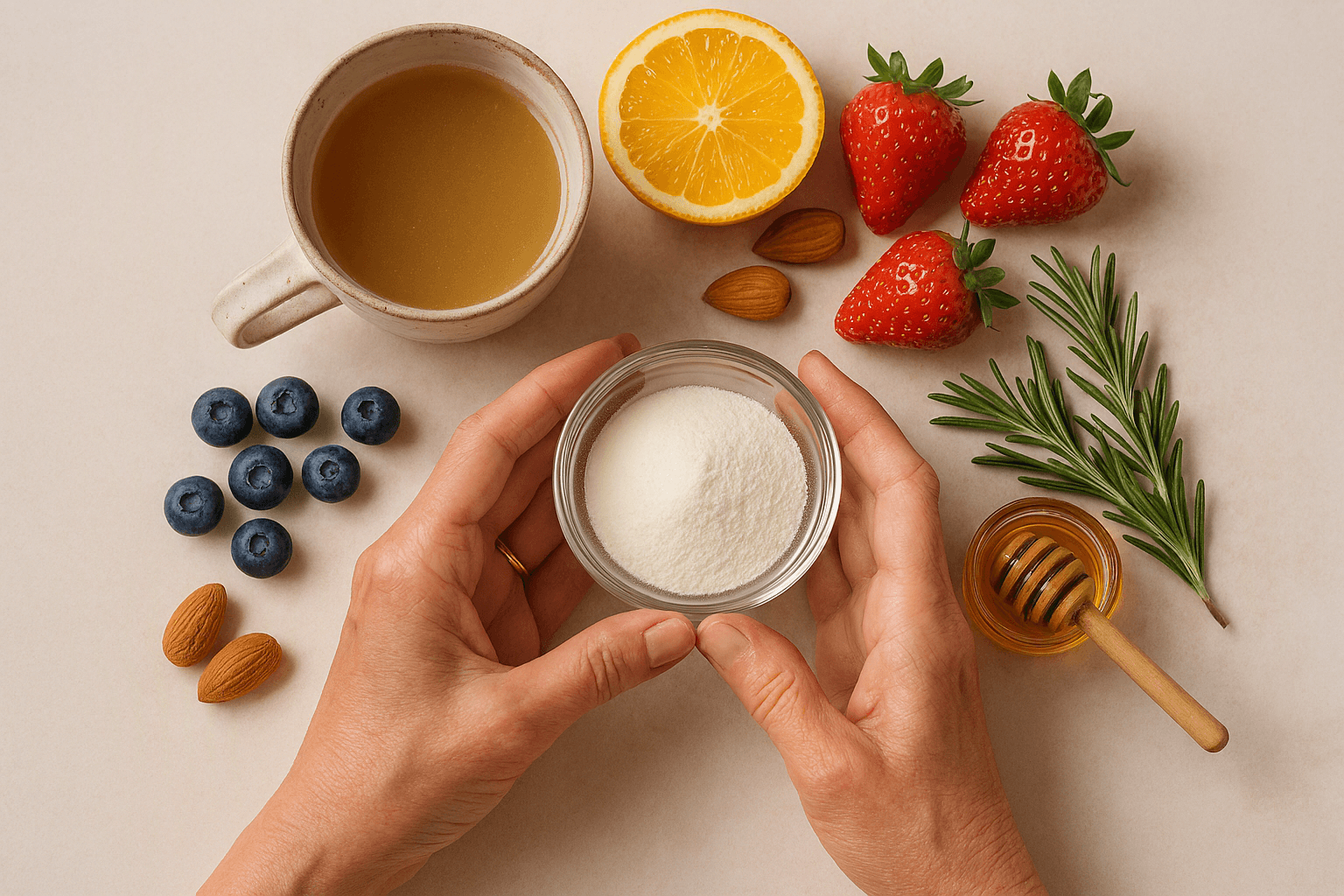
- ✅ Easy mixing powder — dissolves in water, coffee, or smoothies
- ✅ Non-GMO & clean ingredients
Best for women who: Want to address skin, hair, joints, and gut with ONE product (instead of buying 4 different supplements). Especially good for women who feel that “everything changed at once” after 40.
Typical results timeline:
- Weeks 1–2: Initial body adjustment, possibly slight digestive improvements
- Weeks 3–4: Better hair shine and stronger nails
- Weeks 5–8: Skin starts feeling more hydrated, fewer fine lines
- Weeks 8–12: Joint comfort, recovery, and visible skin improvements
- Months 3+: Cumulative results — most women report not wanting to stop
Affiliate disclosure: We may earn a commission if you purchase through this link, at no extra cost to you. We only recommend products we’ve researched and would recommend to our own family.
What to AVOID When Buying Collagen
- 🚩 Single-type collagen (only Type I) — too narrow for women 40+ multi-system needs
- 🚩 Collagen “drinks” loaded with sugar — many trendy collagen waters are 80% sugar/sweeteners
- 🚩 No source disclosure — if the label doesn’t say “grass-fed bovine” or “wild-caught marine,” skip
- 🚩 Vegetarian/vegan “collagen builders” — these don’t contain actual collagen, just vitamins. They’re not the same.
- 🚩 Beauty drinks with collagen as 9th ingredient — token amount, mostly marketing
- 🚩 Doses under 5g per serving — too low to matter, unless you take multiple servings
- 🚩 “Miracle” anti-aging claims — quality companies talk about support, not miracles
How to Take Collagen Effectively
1. Best Time of Day
There’s no single “best time” — consistency matters more than timing. Most women take collagen with their morning coffee or in a smoothie. Some prefer evening for the calming amino acids (glycine especially).
2. With or Without Food?
Either works. Some studies suggest slightly better absorption on an empty stomach, but the difference is minor. Make it sustainable — if you remember best with breakfast, take it then.
3. Pair With Vitamin C
If your collagen doesn’t include vitamin C, take 500mg–1000mg vitamin C alongside it. Your body needs vitamin C to convert collagen into usable tissue.
4. Combine With Movement
Collagen builds best when paired with regular movement that stimulates connective tissue — walking, strength training, yoga, swimming. Your body produces collagen in response to demand.
5. Be Consistent for 8+ Weeks
Collagen is NOT an instant fix. Real, visible results require 8–12 weeks of daily use. The women who stop at week 3 because “it’s not working” are leaving the actual benefits on the table.
Common Mistakes Women Make With Collagen
- Stopping too soon — quitting at week 3 because there’s no visible change yet
- Taking too little — 2g daily won’t show results; aim for 10g+
- Choosing single-type collagen — limits results to skin only
- Forgetting vitamin C — collagen without vitamin C is much less effective
- Buying based on packaging — pretty packaging ≠ quality ingredients
- Expecting collagen to fix bad lifestyle — supplements work WITH healthy eating, sleep, and movement, not against them
- Ignoring side ingredients — sugar, artificial sweeteners, and fillers undo the benefits
Collagen + Your Overall Wellness Stack
Collagen is one of the most foundational supplements for women 40+, but it works best as part of a thoughtful stack:
- 🌸 Multi-symptom menopause support (like MenoRescue) for hormones
- 🌸 Joint-specific formula (like Joint Genesis) if joints are a major concern
- 🌸 Hair-focused formula (like HairFortin) for severe hair thinning
- 🌸 Collagen Refresh as the foundational beauty & structural support
You don’t need all of them at once. Start with collagen (especially if skin, hair, and joints are concerns) and layer in others as needed. For a complete breakdown of supplement combinations, see our best supplements for menopause buyer’s guide.
Frequently Asked Questions
What’s the best collagen for women over 40?
The best collagen for women over 40 is a hydrolyzed multi-type formula (Types I, II, III, V, X) with vitamin C, from clean sources, with at least 10g per serving. Our top pick is Collagen Refresh by WellMe for these reasons.
How long until I see results from collagen?
Most women notice small improvements at weeks 3–4 (hair, nails), with bigger changes in skin and joints at weeks 8–12. Be patient — collagen is a long-term investment.
Can collagen really reverse wrinkles?
Collagen won’t erase deep wrinkles like a procedure would, but research shows it can reduce fine lines, improve skin elasticity, and increase hydration over 12+ weeks of consistent use. Realistic, not magical.
Is bovine or marine collagen better?
Both work well — bovine contains Types I and III primarily, marine is mostly Type I but highly bioavailable. Multi-type formulas often combine both for full spectrum coverage.
Can I take collagen with other supplements?
Yes — collagen works well alongside most other supplements. It’s especially complementary with vitamin C, hyaluronic acid, magnesium, and most menopause-specific supplements.
Is collagen safe long-term?
Yes, for most women. Collagen is naturally produced by your body, and supplementing it has an excellent safety profile. As with any supplement, talk to your doctor if you have a chronic condition or take prescription medications.
The Bottom Line
The “best collagen for women over 40” isn’t the one with the prettiest packaging or the loudest marketing. It’s the one that delivers what your body actually needs in midlife:
- ✅ Multiple collagen types (not just Type I)
- ✅ Hydrolyzed for absorption
- ✅ Quality sources (grass-fed, wild-caught)
- ✅ Vitamin C included
- ✅ Clean ingredient list (no sugar/fillers)
- ✅ Reasonable dose (10g+)
- ✅ Strong guarantee
For most women in their 40s, 50s, and beyond, Collagen Refresh checks all of these boxes and offers the most comprehensive support for skin, hair, joints, and gut — addressing the multi-system collagen decline that menopause brings.
It’s not a miracle. But for a real, science-backed way to support the structural integrity your body is asking for now, collagen — done right — is one of the smartest investments you can make in your future self. 🌸
✦ Editor’s Note ✦
Want to See How This Compares?
If you’re still researching, our complete buyer’s guide breaks down the best supplements for menopause by category — with what to look for, what to avoid, and our honest top picks in each area.
Related reading: Menopause Joint Pain: Why It Happens & Real Relief | Joint Genesis Review | Hair Loss During Menopause | Best Supplements for Menopause
This article is for educational purposes and does not replace medical advice. Always consult with a qualified healthcare provider before starting new supplements, especially if you have a chronic condition or take prescription medications.