Bone Health After 40: The Silent Concern (And What Actually Helps)
Here’s something most women aren’t told at their 40th birthday: your bones are quietly, invisibly losing density right now. You can’t feel it. You can’t see it. There are no symptoms. And by the time you notice — through an unexpected fracture, a sudden height loss, or a scary DEXA scan result — you’ve already lost 15-25% of your bone mass. This isn’t fear-mongering. This is biology. And it’s exactly why bone health after 40 deserves your attention now, not later.
Here’s the frustrating truth: most women get exactly one piece of advice about bone health after 40 — “take more calcium.” But calcium alone doesn’t build strong bones. In fact, taking calcium without the co-factors your body needs to actually USE it can create bigger problems than it solves. Your bones need a whole ecosystem of support: collagen for the matrix, protein for structure, vitamin D and K2 for absorption, magnesium for balance, hormones for regulation, and movement for stimulation.
This guide will break down what’s actually happening to your bones after 40, why estrogen decline accelerates the process, the “calcium only” myth that leaves so many women underprotected, the 5 pillars of real bone protection, and the natural approaches (including our top supplement picks) that address the actual root causes.
Let’s protect what carries you.
⏱️ IN A HURRY? 30-Second Guide
Your Bone Health After 40 Checklist
🥇 If you want to protect the bone matrix: Focus on collagen support — the flexible protein framework your bones need to stay strong.
🥇 If you have joint pain + bone concerns: Target both with a formula that addresses hyaluronan and inflammation.
🥇 If you’re building a complete foundation: Combine strength training, protein-rich diet, quality sleep, and targeted supplementation.
Now let’s dive into why — and cover what actually works.
What’s Really Happening to Your Bones After 40
Your bones aren’t static objects. They’re living, constantly-remodeling tissue. Every day, specialized cells break down old bone (called resorption) while other cells build new bone (called formation). In your 20s and 30s, formation slightly outpaces resorption — that’s how you build peak bone mass, which happens around age 30.
After 40, this balance starts shifting. Formation slows. Resorption speeds up. And when estrogen begins declining in perimenopause, bone loss accelerates dramatically. The average woman loses:
- 0.5-1% of bone mass per year in your 40s (perimenopause phase)
- 2-3% of bone mass per year in the first 5-7 years after menopause
- Up to 25% of total bone mass in the decade surrounding menopause
These aren’t scary statistics to alarm you — they’re empowering information. Because when you know what’s happening biologically, you can make informed choices about how to slow, stop, or even reverse this trajectory. That’s the entire purpose of paying attention to bone health after 40.
Why Estrogen Decline Wrecks Bone Density
Estrogen isn’t just a reproductive hormone. It plays a crucial role in bone maintenance by restraining the cells that break down bone. When estrogen drops during perimenopause and menopause, those bone-resorption cells go into overdrive — and bone formation can’t keep pace.
This is why women lose bone density faster than men after 40. It’s why 1 in 3 women over 50 will experience an osteoporotic fracture in her lifetime. And it’s why bone health becomes a real priority in the perimenopause and menopause years.
The good news: this isn’t destiny. Understanding the mechanism gives you the tools to intervene early — long before osteoporosis becomes a diagnosis.
Signs Your Bone Health After 40 Needs Attention
Bone loss is called “silent” for a reason — it usually has no symptoms until damage is significant. But these signs suggest your bone health after 40 deserves closer attention:
- You’ve lost more than half an inch in height over the past few years
- Family history of osteoporosis, hip fractures, or spinal compression
- Slight, unexplained back pain (early sign of vertebral micro-fractures)
- Weak grip strength (correlates with overall bone density)
- Brittle fingernails that break easily
- Receding gums or dental problems
- History of very low body weight or eating disorders
- Long-term use of medications that affect bones (steroids, some antidepressants, PPIs)
- Smoker or heavy alcohol use
- Sedentary lifestyle without weight-bearing exercise
- Early menopause (before age 45) or surgical menopause
- Chronic stress or elevated cortisol (steals from bone)
If several of these apply to you, consider requesting a DEXA scan (bone density test) from your doctor to establish your baseline. Knowledge is protection.
The “Calcium Only” Myth (And Why It Fails You)
Here’s the biggest misconception about bone health after 40: that calcium is the answer. It isn’t — at least not by itself.
Think of your bones like reinforced concrete. Calcium is the concrete — the hard mineral component. But concrete alone is brittle. What makes reinforced concrete strong is the flexible rebar framework inside it. In your bones, that rebar is collagen — a protein that provides the flexible matrix onto which minerals are deposited.
Without adequate collagen, calcium has nothing to bind to. You end up with brittle bones that snap under pressure instead of flexing. This is why:
- Women who take only calcium often still develop osteoporosis
- Excess calcium without co-factors can cause kidney stones and arterial calcification
- Bone breaks in older women are often from brittle, not just thin, bones
Real bone health after 40 requires supporting BOTH the mineral component AND the collagen matrix — plus the co-factors your body needs to properly use everything.
The 5 Pillars of Real Bone Protection After 40
Pillar 1: Support the Collagen Matrix
Collagen makes up 30-40% of bone tissue. Support your body’s collagen production with high-quality supplements, protein-rich nutrition, and co-factors like Vitamin C, Copper, and Zinc. This is often the missing piece in traditional bone health advice.
Pillar 2: Provide Mineral Building Blocks
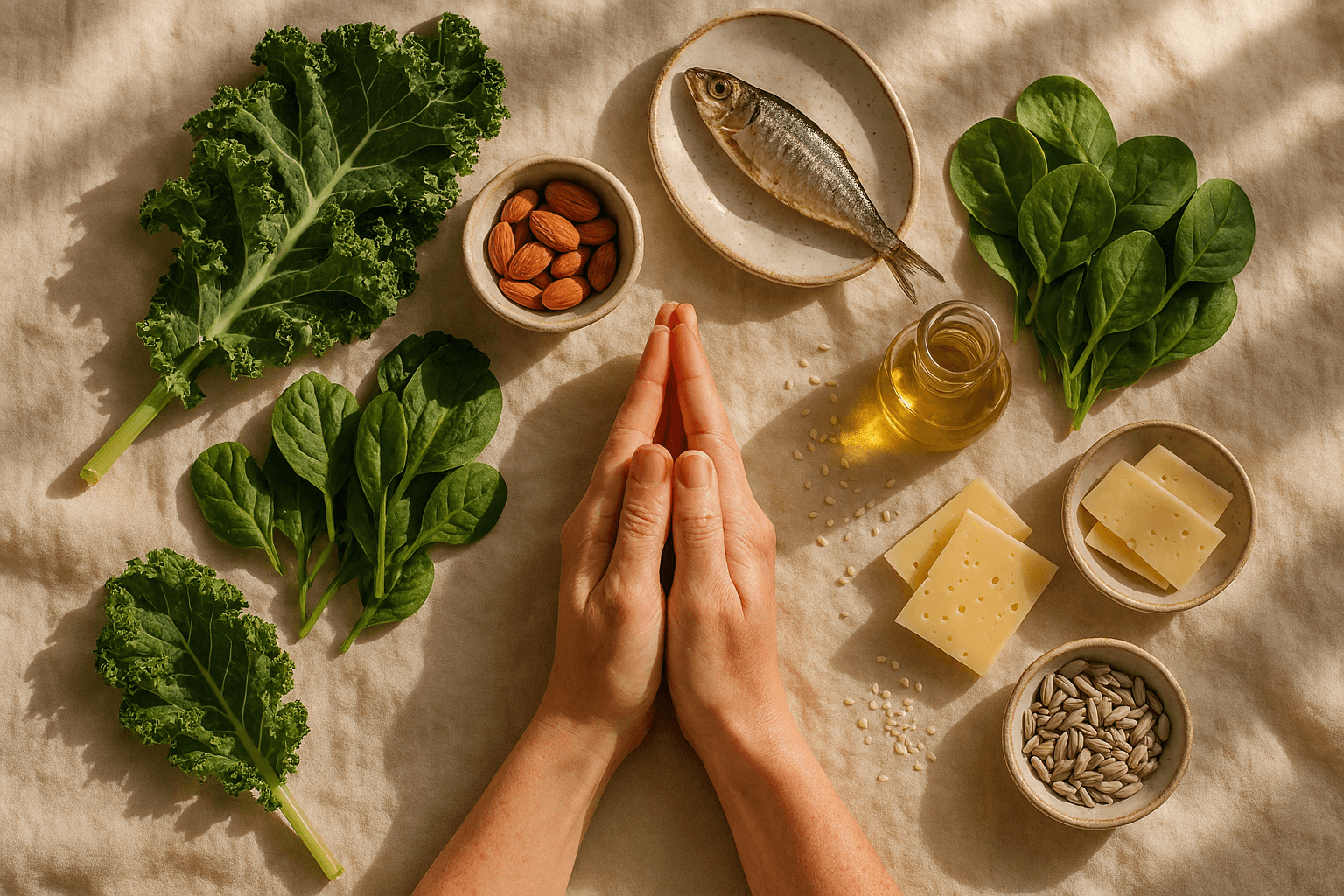
Calcium (from food ideally: leafy greens, dairy, fatty fish, almonds), Magnesium (essential co-factor most women lack), Vitamin D (needed for calcium absorption), and Vitamin K2 (directs calcium into bones, away from arteries).
Pillar 3: Load Your Bones with Movement
Bones respond to stress by getting stronger. Weight-bearing exercise (walking, hiking, dancing), impact exercise (jumping, running), and especially strength training after 40 are non-negotiable for maintaining bone density. Aim for 2-3 strength sessions per week.
Pillar 4: Address the Hormonal Factor
Since estrogen decline drives bone loss, supporting hormonal balance protects bones. This can include HRT (discuss with your doctor), phytoestrogen-containing foods (soy, flax, chickpeas), or targeted hormonal support supplements that address the cortisol-estrogen chaos affecting bone metabolism.
Pillar 5: Protect What You Have
Reduce bone-stealing habits: excess alcohol (limit to 1 drink/day maximum), smoking (quit — it accelerates bone loss dramatically), excessive caffeine (2-3 cups max), and chronic stress (cortisol directly steals bone minerals). Support your foundation with a nutrient-dense diet plan.
Our Top Picks for Bone Health After 40
After researching the market, two supplements stand out for women prioritizing bone health after 40. They work on different pathways — and many women benefit from combining them for comprehensive support.
🏆 Best for the Collagen Matrix: Collagen Refresh
Collagen Refresh by WellMe addresses the missing piece most bone protocols ignore: the collagen matrix that gives bones their flexibility and strength. Its “Refreshed Collagen” approach doesn’t just provide animal collagen — it stimulates your body’s own production of Triple Helix collagen through key co-factors (Copper, Vitamin C, Vitamin E, Polypodium Leucotomos). Combined with Type I and Type III collagen peptides from bovine, eggshell, and marine sources, plus Hyaluronic Acid — it provides comprehensive matrix support that pure calcium supplements can’t offer.
Read our full Collagen Refresh review here for the detailed breakdown.
🏆 Best for Joint + Bone Combined Support: Joint Genesis
Joint Genesis by BIODYNAMIX targets the hyaluronan-inflammation pathway that affects both joints AND bone matrix. Its patented Mobilee® ingredient multiplies hyaluronan by 10x — supporting the synovial fluid AND the connective tissue that surrounds bones. Combined with French Maritime Pine Bark (anti-inflammatory), Boswellia Serrata, Ginger, and BioPerine®, it addresses the inflammation that accelerates bone loss. Best if you have joint stiffness alongside bone health concerns.
Read our full Joint Genesis review here for the detailed breakdown.
Affiliate disclosure: We may earn a commission if you purchase through these links, at no extra cost to you. We only recommend products we’ve personally researched and would recommend to our own family.
💡 Reality Check: Bone health responds to consistent, long-term care — not quick fixes. Supplements support but don’t replace the foundational pillars: weight-bearing exercise, adequate protein, vitamin D, magnesium, and hormonal awareness. If you have significant risk factors (early menopause, family history of osteoporosis, previous fractures), ask your doctor about a DEXA scan for baseline measurement. This is educational information — always consult your healthcare provider for medical guidance specific to your situation.
Bone Health After 40: When to See a Doctor
Some situations warrant a medical consultation:
- 🩺 Sudden height loss (more than half an inch)
- 🩺 Unexplained back pain, especially between shoulder blades
- 🩺 Fractures from minor falls or normal activities
- 🩺 Family history of hip or spine fractures
- 🩺 Early menopause (before age 45) or surgical menopause
- 🩺 Long-term use of steroids, PPIs, or other bone-affecting medications
- 🩺 History of eating disorders or low body weight
Ask your doctor about a DEXA scan (bone density test) to establish your baseline. Knowledge is protection — you can’t manage what you don’t measure. Most insurance covers bone density testing for women 45+, especially with risk factors.
Frequently Asked Questions
Can I reverse bone loss after 40?
Slowing bone loss is realistic for most women. Some bone gain is possible with aggressive intervention (strength training + nutrition + supplements + possibly medication). Full “reversal” varies by starting point, genetics, and consistency. The earlier you start, the better the results.
How much calcium do I actually need?
Women 40-50 need about 1,000mg daily; women 50+ need 1,200mg. Get calcium from food FIRST (dairy, leafy greens, sardines, almonds) before supplementing. Too much supplemental calcium can cause kidney stones and arterial calcification. Focus on the ecosystem, not the single nutrient.
Does taking collagen actually help bones?
Yes. Multiple studies show that hydrolyzed collagen peptides can increase bone mineral density in postmenopausal women. Since collagen makes up 30-40% of bone tissue, supporting the matrix directly helps bone strength. Combine with weight-bearing exercise for best results.
What exercises are best for bone health?
Strength training (2-3x/week), impact exercise (jumping, running, dancing), weight-bearing activities (walking, hiking, tennis), and balance work (yoga, tai chi) are all beneficial. Swimming and cycling don’t build bone density because they’re not weight-bearing. See our strength training guide.
Can I take Collagen Refresh and Joint Genesis together?
Yes — they target different aspects (collagen matrix vs hyaluronan/inflammation) and combine well for comprehensive bone and joint support. Many women see amplified results with this combination.
Should I get a DEXA scan?
If you’re over 50, or over 45 with risk factors, yes — establishing baseline is invaluable. Even if numbers are normal, you have a reference point for comparison. If you’re already dealing with symptoms or family history, don’t wait.
Is bone loss inevitable after menopause?
Some bone loss is expected. But severe osteoporosis is NOT inevitable. Women who start protective practices early — nutrition, exercise, targeted supplementation, hormonal awareness — maintain far better bone density than those who don’t.
If You Had to Start With Just One: Our Recommendation
If you can only add one supplement to your bone protection routine, start with Collagen Refresh. Here’s why:
- Collagen is the most overlooked piece of bone health — most women get calcium and vitamin D advice but ignore the matrix protein.
- Bone loss after menopause is primarily matrix degradation, not just mineral loss — Collagen Refresh addresses that root cause.
- The 180-day empty jar guarantee makes it essentially risk-free to test.
- Multiple benefits — same product supports skin, hair, nails, and joints alongside bone health.
- Real research backing — collagen peptides have proven benefits for postmenopausal bone density.
The exception: If your primary experience is significant joint stiffness alongside bone concerns, start with Joint Genesis instead. Its hyaluronan focus addresses both the joint discomfort AND the connective tissue supporting bones.
A Final Word on Bone Health After 40
Your skeleton has carried you through four decades of life. It’s danced at your wedding, held your babies, hiked mountains, and gotten you through every day. It deserves attention now — not after a break, not after a diagnosis, but while you still have the ability to protect it fully.
The truth is — bone health after 40 is deeply responsive to intentional care. Support the collagen matrix. Move your body meaningfully. Nourish with quality protein and minerals. Get your Vitamin D checked. Address the hormonal factors. Track your baseline with a DEXA scan. And know that every choice you make from today forward compounds into decades of mobility, independence, and strength.
You’re not “just getting older.” You’re entering the phase of your life where intentional care matters more than ever — and where the small daily choices you make now determine the vibrant, strong, mobile decades ahead.
Protect what carries you. Bloom on, beautifully. 🌸
✦ Editor’s Note ✦
Want the Bigger Picture?
Bone health is one part of the wellness puzzle. Our complete guide covers the best supplements for menopause by category — including our top picks for hormones, joints, skin, thyroid, and more.
Related reading: Collagen Refresh Review | Joint Genesis Review | Strength Training After 40 | Best Supplements for Menopause
This article is for educational purposes only and does not replace medical advice. Always consult with a qualified healthcare provider about bone health concerns, especially if you have risk factors or existing conditions.